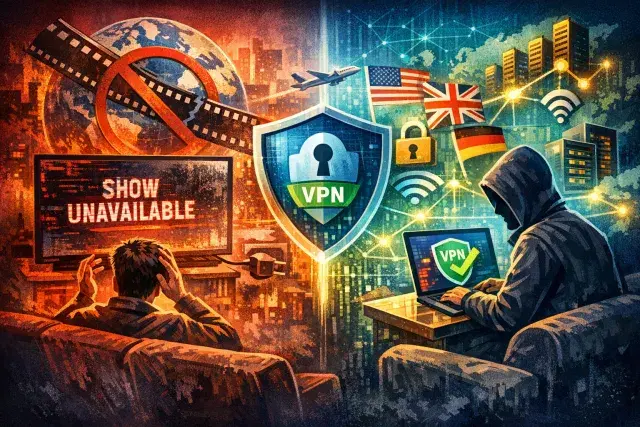

Broadcast rights carve the world into digital territories, meaning that where a viewer happens to be physically located determines what they can legally stream. The Saudi Arabia versus Uruguay group stage fixture on June 15, 2026 - kicking off at 6:00 PM local time (11:00 PM BST) at Hard Rock Stadium in Miami Gardens, Florida - is available through dozens of broadcasters worldwide, but each one is locked to a specific region. A Virtual Private Network, commonly known as a VPN, is the most widely used tool for crossing those invisible borders.
How Geo-Restrictions Work - and Why a VPN Bypasses Them
When you visit a streaming platform, the service reads your IP address to determine your country. If your location falls outside the rights holder's licensed territory, access is denied. A VPN routes your internet connection through a server in another country, replacing your actual IP address with one from that server's location. The streaming platform then registers you as being present in that country and grants access accordingly.
This is not a loophole in any exotic technical sense - it is simply the same tunneling technology that corporations have used for decades to give remote employees secure access to internal networks. The underlying mechanism, typically built on protocols such as OpenVPN, WireGuard, or IKEv2, encrypts the data traveling between your device and the VPN server, shielding it from third-party interception along the way. For viewers concerned about privacy beyond mere geo-restriction, that encryption layer has genuine value regardless of what they are watching.
Reliable paid providers - ExpressVPN, NordVPN, and Surfshark are among the most widely reviewed - offer dedicated apps across mobile and desktop platforms. Free VPN services exist, but they frequently impose data caps, maintain fewer servers, and, in some documented cases, monetize user data in ways that undermine the privacy benefit the tool is supposed to provide.
Where to Watch: A Global Broadcast Breakdown
The fixture carries extensive free-to-air coverage in several countries, alongside premium pay-TV and streaming options elsewhere. In Uruguay, Canal 5 - the national public broadcaster - carries the event live and free of charge, with streaming also available through Antel TV. Pay-TV and streaming subscribers in Uruguay can additionally access DirecTV Sports (DSports) and its DGO app. In Saudi Arabia and across the broader Middle East and North Africa region, beIN SPORTS holds exclusive rights, with live coverage distributed through its dedicated MAX channels and the beIN CONNECT app.
The worldwide footprint is substantial. Key broadcasters by region include:
- United Kingdom / Ireland: RTÉ (Ireland)
- France: M6, M6+, beIN Sports 1, beIN SPORTS CONNECT, 6play, myCANAL
- Germany: ZDF, MagentaTV
- Italy: RAI 1, RaiPlay, DAZN Italia
- Spain / Andorra: TVE La 1
- Netherlands: NPO 1, Ziggo Go, Canal+ Netherlands
- Australia: SBS, SBS On Demand
- Canada: TSN1, TSN+, CTV, CTV App, Crave
- Brazil: Globo, Globoplay, SporTV, SBT, CazéTV
- Mexico: Canal 5 Televisa, Azteca 7, TUDN En Vivo, ViX Mexico
- Argentina: Telefe, DIRECTV Sports, DGO, Paramount+
- Japan: DAZN Japan
- Indonesia: TVRI, TVRI Sport, Vidio
Multiple Latin American countries - including Chile, Colombia, Ecuador, and Peru - have access via DIRECTV Sports and DGO, with Paramount+ offering an additional streaming tier in several of those markets.
Using a VPN: Three Steps to Access Any Regional Feed
The practical process is straightforward. First, subscribe to a paid VPN service and install its application on your preferred device - most major providers support smartphones, tablets, smart TVs, laptops, and browser extensions. Second, open the app and connect to a server located in whichever country carries the broadcast you want. If you want to access SBS in Australia, for instance, connect to an Australian server. Third, open the streaming platform, log in if required, and begin watching.
One practical note: some streaming services actively detect and block known VPN IP ranges. Premium providers tend to rotate their server addresses frequently to stay ahead of these blocks, which is one concrete reason paid services outperform free alternatives in this specific use case. Connection speed also matters - choose a server geographically close to the target country where possible, since longer routing paths can introduce latency.
Legal and Practical Considerations Worth Understanding
The legality of VPN use varies by jurisdiction. In most Western democracies, using a VPN is entirely lawful. Several countries - including some in the Middle East, Central Asia, and parts of Southeast Asia - either restrict VPN use or require that only government-approved services be used. Viewers should verify the rules applicable in their physical location before connecting.
Streaming platforms' terms of service typically prohibit circumventing geo-restrictions, and a platform retains the right to suspend accounts that violate those terms. That risk is generally borne by the individual account holder. For most viewers in permissive legal environments, however, the practical consequence is simply that the service may block the VPN connection - not that the viewer faces any legal exposure. Understanding that distinction is important before deciding whether a VPN suits your situation.