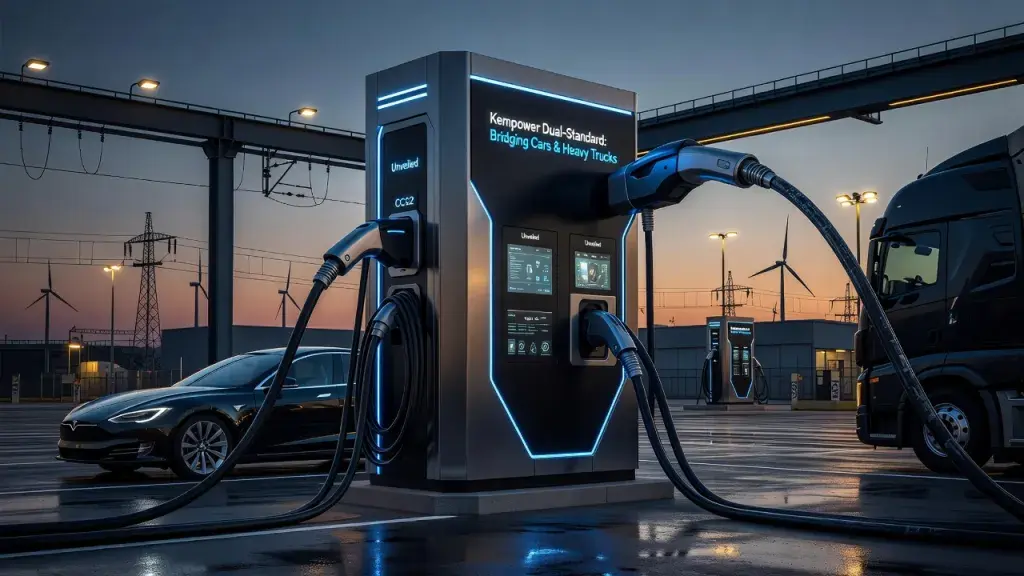
Kempower has introduced a charging unit designed to solve one of the thorniest problems in electric transport infrastructure: how to serve passenger cars and heavy-duty trucks at the same site without building two separate systems. The new Mega Satellite Flex supports both the established CCS standard, at up to 560 kW, and the emerging Megawatt Charging System, at up to 1.2 MW, making it the company's first dispenser capable of switching between the two.
The timing reflects a genuine inflection point in the industry. CCS has dominated electric vehicle charging for years, built around the power requirements of passenger cars and light commercial vehicles. But heavy-duty trucks operate on a different scale entirely, needing far more energy delivered far faster to keep freight schedules intact. MCS was developed specifically for that purpose, and its rollout is still in its early stages across North America and Europe. Just as drivers increasingly look for tools like a vpn without a credit card to reduce friction in digital services, charging site operators are looking for infrastructure that removes friction from physical logistics - equipment that adapts rather than requiring a second, costly buildout.
Why One Dispenser for Two Standards Matters
Building charging infrastructure is capital-intensive, and the return on that investment depends heavily on how much a site gets used. A location that can only serve passenger vehicles sits idle when trucks pass by needing power, and vice versa. By supporting both CCS and MCS from a single unit, Kempower is betting that operators will get higher utilization rates from day one, rather than waiting years for truck traffic to justify a dedicated megawatt installation. That is a meaningful shift in how charging sites might be planned going forward, since it lowers the risk of stranded investment in a market still working out where heavy-duty freight routes will concentrate.
The unit also accommodates newer 800-volt vehicle architectures, which are becoming more common among premium passenger EVs and are prized for their faster charging speeds. That forward compatibility matters because vehicle electrical systems are trending toward higher voltages across categories, and infrastructure installed today needs to remain relevant as that shift continues.
Technical Specifications and Practical Deployment
The Mega Satellite Flex is rated for up to 1,500 amps on the MCS side and 700 amps for CCS, with cable lengths of 5 meters for CCS connections and 2.7 meters for MCS. An optional payment terminal can be integrated directly into the unit, simplifying the customer experience at public sites. Kempower has also designed it to work within its existing distributed charging architecture, meaning operators already running Kempower systems can add the new dispenser without reengineering their electrical or software infrastructure.
- CCS charging: up to 560 kW, 700 amps, 5-meter cable
- MCS charging: up to 1.2 MW, 1,500 amps, 2.7-meter cable
- Compatible with 800-volt vehicle platforms
- Optional integrated payment terminal
- Works with Kempower's existing distributed charging systems
What Comes Next
Kempower revealed the Mega Satellite Flex at its Unplug & Recharge event held alongside ACT Expo, a gathering focused on advanced transportation technology, where the unit remains on display this week. The company expects to bring it to market in North America and Europe in July 2026, giving operators time to plan sites that anticipate both current passenger EV demand and the growing need for heavy-duty truck charging. Whether the dual-standard approach becomes an industry norm or remains a Kempower differentiator will depend largely on how quickly MCS infrastructure spreads and how other manufacturers respond.