
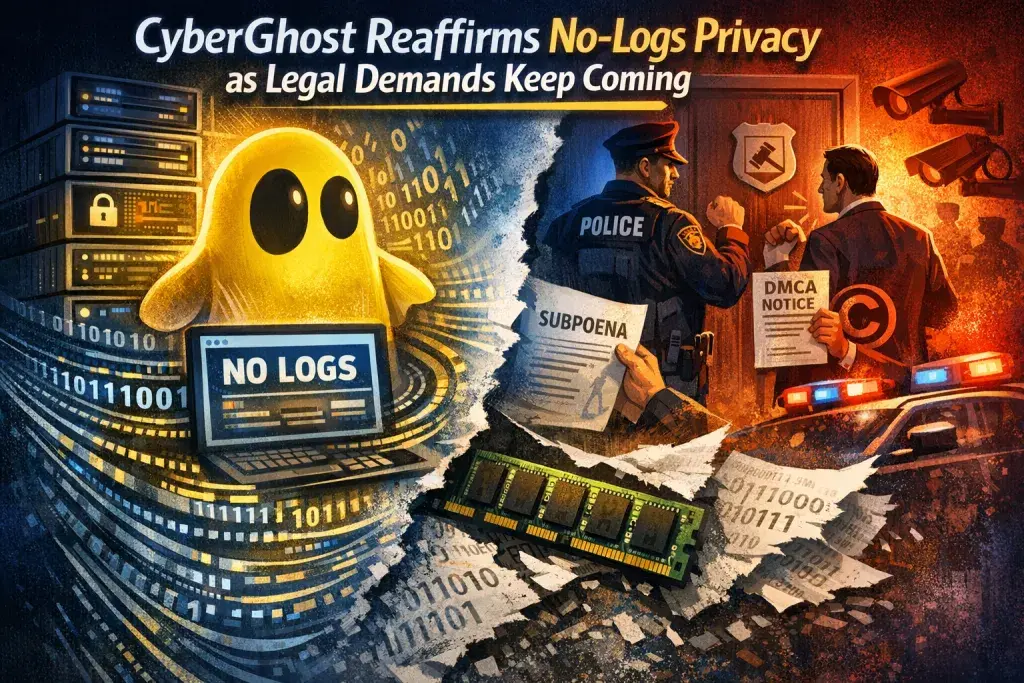
CyberGhost says it began 2026 facing the same pressure that closed out the previous year: a steady flow of requests seeking to tie VPN IP addresses to real people. Its latest transparency report, covering January through March, argues that the core privacy promise of a VPN only matters when a provider has structured its systems so there is nothing meaningful to hand over.
That claim matters because VPN companies sit at a sensitive point in the internet’s plumbing. They route user traffic, mask IP addresses, and become an obvious target for copyright enforcers and police agencies seeking identifying data. Whether a provider logs activity is not a marketing detail; it is the difference between being able to comply with a demand and being technically unable to do so.
What the first-quarter numbers show
According to the report, CyberGhost received 53,533 DMCA complaints in the first quarter of 2026: 19,296 in January, 15,973 in February, and 18,264 in March. It also received four police requests, two in January and two in February. That is slightly below the 56,053 DMCA notices the company says it received in the final quarter of 2025, but the volume remains high enough to show how routine and automated these demands have become.
For copyright holders, the aim is straightforward: identify a user allegedly linked to downloading or sharing protected material. For law enforcement, the requests can be broader, tied to ongoing investigations. CyberGhost’s response in both cases is the same. It says its no-logs policy and RAM-only infrastructure mean it does not retain browsing histories, connection timestamps, or traffic records that could connect a customer’s identity to a specific session.
Why infrastructure design matters more than privacy slogans
Privacy claims are easy to advertise and harder to verify. The practical question is whether a company has built its network to minimize what exists in the first place. Running servers on volatile memory is one way to reduce persistence, because data is erased when a server reboots. That does not by itself prove a provider is private, but it does point to an operational model designed to avoid long-term retention.
This is why transparency reports matter. They do not eliminate the need for scrutiny, but they give users a clearer picture of the legal pressure a provider faces and how often authorities come knocking. In the VPN market, where trust is central and visibility is limited, regular reporting is one of the few tools available to test whether a company’s public promises are matched by repeatable practice.
Bug bounty results point to a different kind of accountability
CyberGhost also says its YesWeHack bug bounty program produced 20 submissions in the quarter, five of them valid enough to be patched and resolved, with the remaining 15 classified as invalid or informational. That result is less about raw volume than about posture. Security is not a fixed state, and companies handling sensitive traffic cannot rely only on internal review.
Inviting outside researchers to probe apps, backend systems, and infrastructure reflects a broader lesson from modern cybersecurity: flaws are often found at the edges, in overlooked configurations, dependencies, or operational shortcuts. Even reports that do not expose a critical weakness can help confirm that protections are working as intended.
The wider threat picture is getting harsher
The quarter’s broader security news reinforces the case for reducing trust wherever possible. CyberGhost points to attacks affecting TELUS Digital, ignition interlock provider Intoxalock, medical technology giant Stryker, and a warning from the US Federal Communications Commission about ransomware pressure on telecoms. The pattern is familiar: third-party access expands exposure, digital outages now disrupt physical systems, and some attackers are moving beyond extortion toward outright destruction.
For users, that means digital privacy can no longer be treated as a niche concern or a matter of personal preference. It sits alongside resilience and safety. A VPN does not solve every security problem, and it cannot protect a person from weak passwords, phishing, or breaches at services they use. But when cyber incidents are growing more invasive and more operationally damaging, data minimization remains one of the few defenses that still works after an attacker, a rights holder, or a government agency comes asking.